"We're not ready yet." "That's something for next year's roadmap." "We have more urgent priorities to fund." In retail, these comments are common — and sometimes justified. Delay doesn't always kill you. And if it does, it's often slow.
In retail media? I'm not so sure delay is survivable. If you're a retail media leader hearing this from your business, send this article to your CFO — because as I've noted before, retail media doesn't grow on trees. And if you stick around to the end, I'll get to the part where we talk about the 541% IRR over five years that a small incremental investment can create.
If my hypothesis is right — that retail media is now a core pillar of retail survival — then waiting, growing at the market's pace, or having your internal teams build from scratch over the next three years might be the riskiest move a retailer can make today. Not just for their ability to compete in retail media, but for their business overall.
The longer you delay, the stronger the pull gets away from your business — the pull of your customers, your data, your top talent, your sales. I talk about leapfrogging in this newsletter — how new and emerging entrants can outmaneuver incumbents with the right moves. But here's the flip side: the longer you wait, the harder that leap gets. You're not just behind on features. You're behind on learning. Behind on talent. Behind on trust.
This isn't a scare tactic. It's economics. Inaction isn't passive. It's a decision to fund someone else's growth instead of your own. So why is investing in this space so hard from a retailer perspective?
Part No. 01The comfort of spreadsheets.
One of the things that fascinates me about our space is that almost every RMN uses some combination of email, spreadsheets, and manual data entry to manage its business. 'Hands on keyboards' is what we call it.
Based on where we are as an industry, that makes sense — most technologies, tools, and architectures simply don't exist to allow for automation today. And even when they do, many retailers aren't willing to invest. This makes it really hard for advertisers to work with you. Either you hide the complexity by doing the work for them, or you ask them to use disparate tools separately and manage the complexity on their end. And frustratingly, businesses in our space are often okay with this.
Part No. 02Retail math vs. retail media math.
Retail has always been a numbers game. You open a store, drive foot traffic, manage inventory, and aim for consistent profit margins. The math is straightforward, reliable, and proven.
But when it comes to retail media, that same formula doesn't apply. Retail media operates on a different economic model — less about foot traffic, more about impression volume, audience segmentation, and establishing a competitive B2B offering. For retailer CFOs, why invest millions in the unknown of retail media when they can open another store and immediately see cash flow?
But here's the math people rarely talk about. Retail media can drive incremental sales, traffic, and change within legacy retail organizations. It can also be highly profitable at maturity (note: profitability is contingent on driving mutually beneficial value to your suppliers — it's not a tax). And when you look at it on a per-head basis, it's glaring.
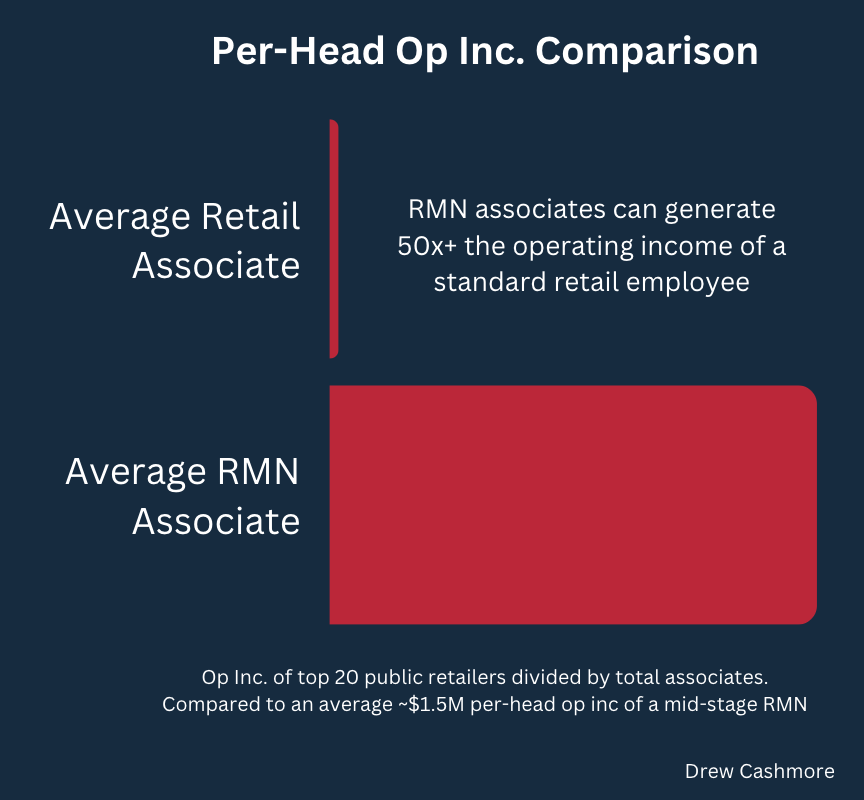
In my career in retail and retail media, I've run up against the normalization of resources across an entire retail organization constantly. And it inevitably means most RMNs are left resource-constrained in perpetuity. But if delivering profitability is important to your organization, you might want to reconsider how you allocate resources — even if the initial return is a quarter of this.
Part No. 03The economics of waiting.
This week's underlying message is the need to invest upfront in the growth of your retail media business — not as a slight increase in COGS, but as a real capex / opex investment. Let's use a bit of 'retail math' to get to the point:
- A retail store in a mature market costs an estimated $350–$473 per square foot (Autodesk).
- So a 50,000-square-foot store might cost ~$20M to build.
- Assuming my ChatGPT math is correct, the average big-box store might get a 19.12% IRR over a 5-year period.
But what about retail media in comparison? Vantage — a company I work with that focuses on connecting the pieces of retail media technology and simplifying workflows — has real insight here. For a $20M retail media network in a holding pattern (early stage, but this model scales out to larger RMNs too), the opportunity cost of delaying investment is substantial. By choosing to grow at market pace over the next five years, a retailer running a $20M RMN today could miss out on:
- $118Mcumulative incremental net revenue
- $18.4Mresource efficiencies
- $6.4Mcapex savings
- $1.2BNincremental retail sales
The incremental cost to capture this upside and create a truly competitive offering? Less than $6M over five years — a fraction of the potential return, and a fraction of what Walmart and earlier entrants paid to enter this space (because the technologies and playbooks exist today to simplify the go-to-market).
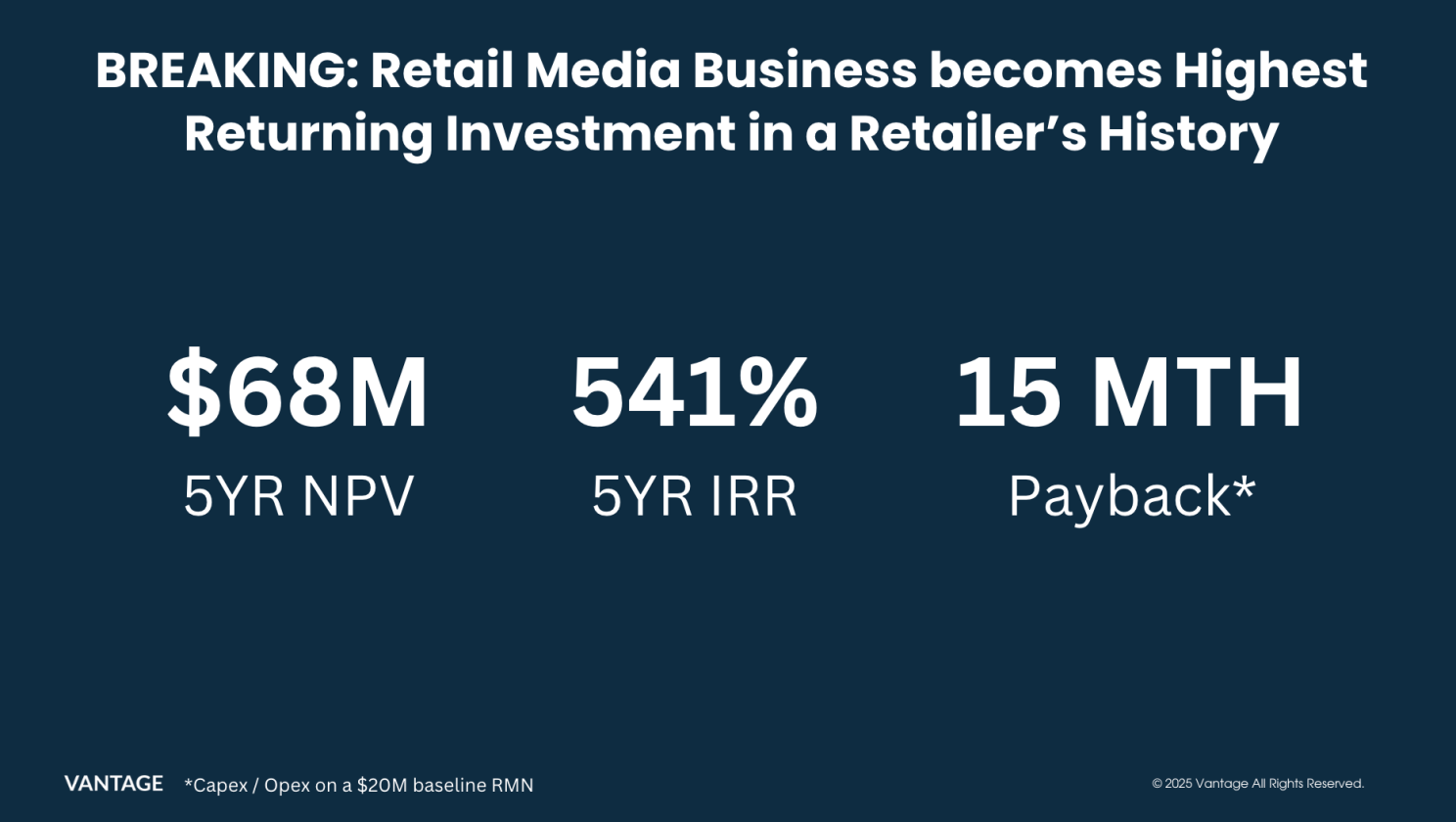
Retail media money doesn't grow on trees — but it doesn't have to cost that much. Invest in your growth and the upside is almost unbelievable.
Getting there.
There's a lot more to this than just an investment — you don't build a store and expect product to appear on the shelf. That's what this newsletter is all about: helping retail leaders with tools, tips, and tricks from myself and other retail media leaders who have built this before.
Transitioning from email and Excel to purpose-built platforms isn't just a systems upgrade — it's a mindset shift. You're not just implementing new tools; you're unwiring old habits, redefining how teams work together, how decisions get made, how performance is tracked. It's asking people to stop being heroic problem solvers and start being disciplined operators. Managing through change within an organization takes a certain type of leader.
If this resonated, share it, comment, push back. And subscribe to the Retail Media Leapfrog Series for more.