Advertisers are demanding it. Retailers see it as a great unlock. But not all self-serve is created equal — and in this week's Retail Media Leapfrog Series, a collection of thoughts designed to help retailers leapfrog incumbents by learning from the past, I'm arguing that self-serve has quietly become one of the biggest bait-and-switches in retail media.
Yes, advertisers say they want to manage their own campaigns. But the real question retailers need to ask is: how? and why? Because if you believe the core thesis — that rest-of-market grows only when we make retail media:
- Easier and more appealing to buy, and
- Easier and more efficient to operate
…then today's self-serve tools are actually doing the opposite. They splinter the buy. They splinter the data. They splinter the customer experience. But most importantly, self-serve today often removes retailers from a seat at the table — splintering their relationship with advertisers (suppliers).
So this week, we're defining self-serve in retail media — and how retailers and advertisers can maintain a direct relationship while still offering self-serve capabilities.
Part No. 01Self-serve-ish.
If you've read this far, ask yourself: how do I define self-serve? An analytics dashboard? A tool to buy PLAs across multiple retailers? Allowing advertisers to buy in their own seat in a DSP or on Meta? Here's what I'm seeing the most of as it relates to "self-serve" today:
-
Product Listing Bidding PortalBidders that traditionally supported product listing ad buys on Amazon, expanded into other retailers to allow network buys.
-
Programmatic OnsiteOnsite inventory made available via SSPs and DSPs for advertisers to buy onsite.
-
Cleanroom Audience ShareAdvertisers power offsite buys in their own seats, leveraging retail audiences passed to DSPs.
-
In-Store DOOHProgrammatic buys into in-store screens.
-
SocialSocial sites allowing advertisers to buy retail-shared audiences in their own seats.
-
Data DashboardA portal for brands to log into to see their campaign performance.
Retail media as a whole is moving away from a purely managed-service proposition and into a more hybrid one. But that shift seems to be placing the burden of management on the advertiser.
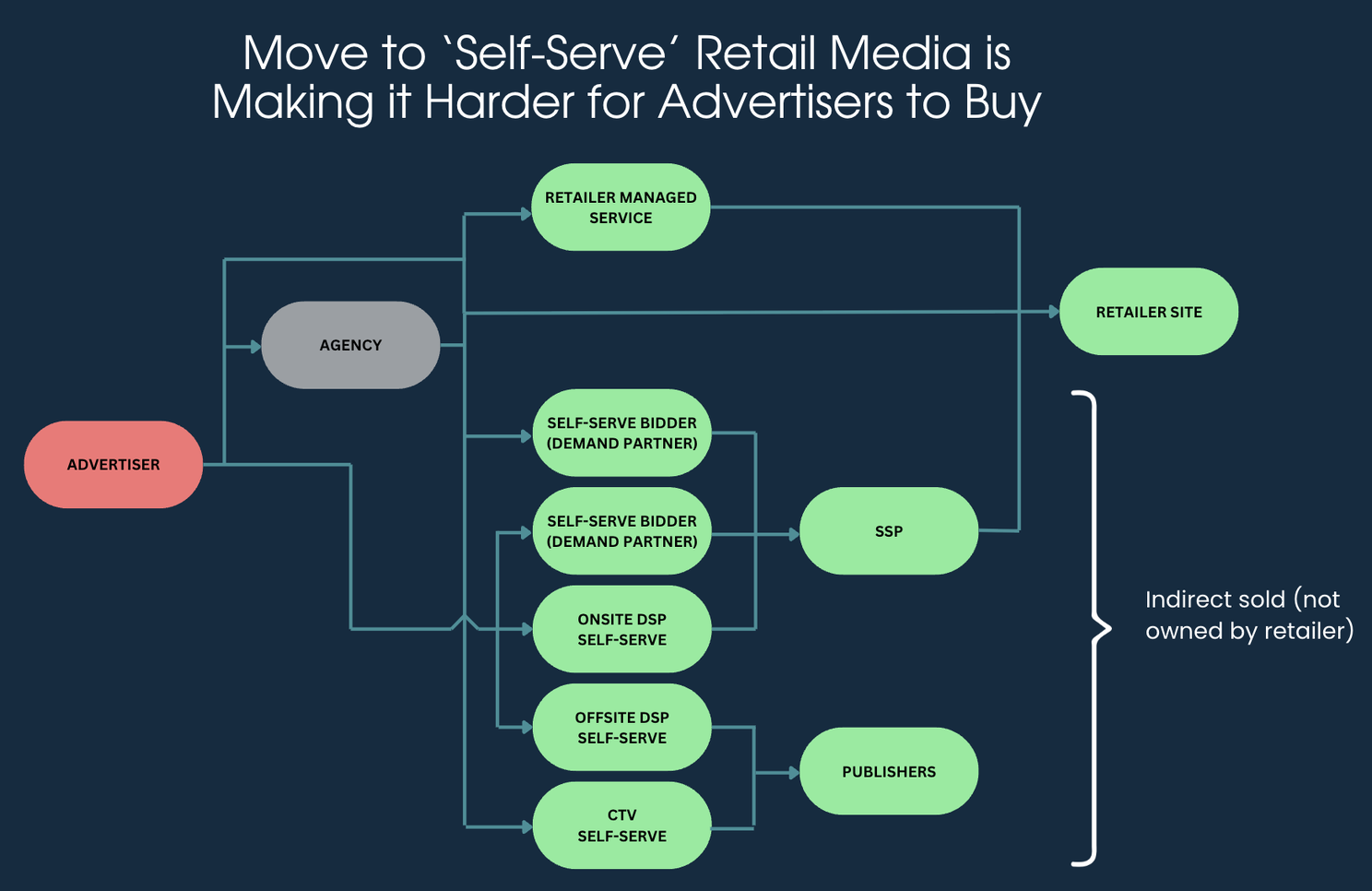
The result? We're not enabling advertisers — we're just redistributing the mess. The same operational and measurement complexity that retailers struggled with in managed service is now in the hands of the advertiser.
Yes, advertisers can buy product listing ads across multiple retailer websites — and maybe display as well. That makes it easier for that tactic. But what about video? In-store screens? CTV? Social? Offsite programmatic? Physical signage? Coupons? Non-endemic?… you catch my drift.
Part No. 02A path to irrelevance.
There's more. In the current construct of self-serve retail media, we're making it harder for advertisers to buy. But more importantly, we're commoditizing retail media's value.
The pitch from a lot of technology players always goes like this: advertisers want to buy from their own seat → retailers need to open up inventory to meet them where they are → more money will flow in. But what the pitch leaves out is that when an advertiser sits in a DSP evaluating fifty retail media networks simultaneously — plus all their other media — their incentive to choose you specifically is essentially zero.
Ask any publisher who lived through the ad network transition what happened when they opened their inventory to programmatic pipes and fired their direct sales team. They'll tell you the same thing — more buyers in theory, but CPMs drop, margin erodes, direct advertiser relationships evaporate, and scarcity of value is traded for volume.
And the media buyer buying through a DSP or bidder is almost always optimizing for efficiency and reach — low cost, maximum reach. As a retailer, you likely have none of those things today — therefore you don't get bought.
Importantly, I'm not saying programmatic solutions or bidders have no role here. They do. In the framework of 'make it easier to buy' and 'make it easier to operate,' one of the many paths to growth is allowing advertisers to buy how they want. Walmart and Amazon have done it to great success.
But what no DSP or bidder will tell you is that that access is paired with significant, dedicated, and direct relationships with advertisers. Walmart and Amazon are not simply hoping someone will buy them — they are investing heavily in driving those relationships.
Part No. 03Redefining self-serve in retail media.
Let me reiterate:
- You should absolutely offer self-serve. It's not optional — it's expected. Advertisers want more control, and the right solution can unlock serious scale.
- If built thoughtfully, self-serve drives incremental value — for you and your advertisers. It can grow spend, improve margins, and enhance the customer experience without cannibalizing existing revenue. (Call me, I'll show you how.)
- There's room for a hybrid model. Direct-sold and network-based self-serve can coexist. What matters is that you stay in the driver's seat — owning the relationship, the data, and the strategy.
But you need to own a direct relationship with your advertiser, full stop. And you need to make it easy to buy all of you in one place — not just self-serve at a tactic level.
Don't be fooled by the dominant vendor voices in the room: advertisers will buy from you today — even if you make them take a few extra steps — so long as you create enough value for them as a business. And if you don't, they won't be buying from you anyway. Real self-serve in retail media is:
- Unified, not tactic-specific.
- Guided, not overwhelming.
- Connected, not fragmented.
- Retailer-led, not outsourced.
Self-serve should feel like a single front door to your retail media business, that you own. Not a choose-your-own-adventure of disconnected tools and vendors — and not diminishing your value to a line-item on a much bigger plan.
I asked ChatGPT to give me something pithy off the above, and it wrote something wonderful:
If this resonated, share it, comment, push back. And subscribe to the Retail Media Leapfrog Series for more.