
It was 2015 when Walmart's Chief Merchant said: "no more advertising or shopper marketing — it must all go into price." An estimated $1B shopper marketing program disappeared overnight — a dramatic shift for a retailer that started its business in the 1960s with sponsored in-store experiential.
Did the ask work? About 60% of those budgets went into price (or Trade). The rest went to Target and Amazon's shopper marketing and retail media programs. It would take Walmart five years to recoup those lost investments.
This said two things about the time:
- Some of Walmart's suppliers' shopper marketing investments were budgets that could have been allocated to price — ultimately reducing the cost of goods for customers.
- Some of those budgets could not be allocated to price, and in lieu of a working shopper marketing model, the budgets went to competing retailers.
I argued last year that the lines between Trade and retail media are blurring — that there is an erosion in 'Trade' budgets that are the driving force in a retailer's ability to offer low prices.
Now we have a clearer picture. James Taylor, referencing data from Forrester and Digiday, put together an incredible visualization of this shift.
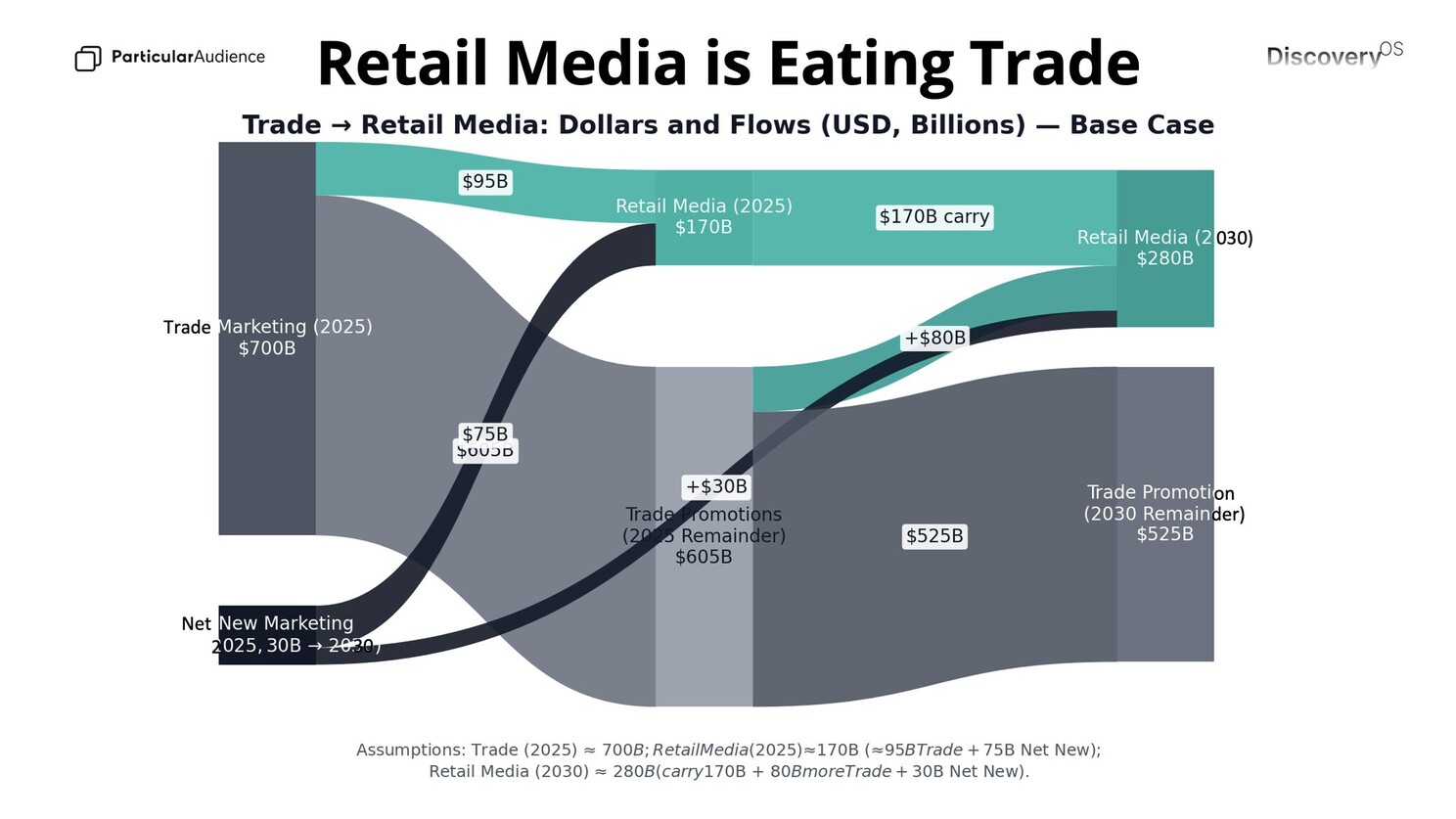
Let's be clear what this says:
But most important is where the growth comes from. By 2030, an extra $30BN will come from net-new marketing dollars, while another $80BN will shift out of the 'Trade' bucket into retail media. Retail media leaders are rightfully obsessed with proving their dollars are incremental — but according to this data, less than 30% of the growth in retail media over the next five years is truly incremental.
In this week's Retail Media Leapfrog Series — a collection of thoughts designed to help retailers leapfrog incumbents by learning from the past — I'm arguing that one of the smartest things you can do today as a retailer is prepare for this shift, not fight it.
Part No. 01The misclassification of Trade budgets.
It helps to understand the foundations of Trade, shopper marketing, and retail media to truly grasp this shift.
Last year I argued that the advent of shopper marketing — co-marketing with a retailer, funded by suppliers, for the purpose of driving that supplier's business at that retailer — introduced a new bucket of funds into a retailer's ecosystem that merchants saw as a new bucket of funds to extract from.
From a supplier (brand) perspective, the delineation between the initial construct for Trade investments and the new shopper marketing construct were different:
But for merchants, traders, and buyers? Not so much.
And that, I surmise, is why these monies appear so fungible — because a significant portion of 'Trade' investments are simply misclassified.
Part No. 02From defense to offense.
Misclassified or not, Trade is at its core a defense mechanism. It is how retailers negotiate guaranteed volume, stable margins, and price competitiveness. The idea is simple: if you fund my price, I'll fund your distribution. Everyone wins.
But in a world where the shelf has gone digital — one where we're not just competing on price but on attention, convenience, and selection — defense doesn't always win.
Retail media, by contrast, is an offense tool. It doesn't just protect price perception or space on shelf; it actively drives growth with highly measurable outcomes — awareness, conversion, loyalty, and profit. A new flywheel.
However — and I've seen this a lot — the danger is when retailers treat retail media like a more sophisticated version of Trade: another fee for access. A defensive mindset wearing new clothes.
Part No. 03Shifting power between merchants and suppliers.
This shift in mindset changes who holds the power in the retailer–supplier relationship. It changes how merchants negotiate. It changes how suppliers plan. It changes how funding asks are made.
And Amazon is entirely to blame.
The decision of Trade or retail media is no longer binary. Amazon has taught the market to expect something in exchange for those investments — growth, ROAS, increased presence.
As suppliers become smarter about how they place their dollars — Trade, national, shopper, retail media, packaging, supply chain — retailers that provide solutions to address mutually beneficial growth will capture a piece of that $80BN shift. Retailers that simply expect consistent or growing Trade investments in perpetuity for limited incremental value will not.
Brands are more in control than ever.
Part No. 04The hidden risk: eroding price competitiveness.
There is a serious risk if we take this too far — if all of these budgets truly become fungible and the give-and-take between supplier and retailer becomes too prescriptive. When Trade dollars leave a retailer's ecosystem, they don't just shrink profitability — they can weaken price competitiveness.
Trade has always been the fuel that allows retailers to sustain low prices and decent margins simultaneously. It's what made "everyday low price" possible in the first place. Retailers that over-rotate into retail media without a corresponding strategy for replenishing or reimagining Trade risk winning the media war while losing the price war.
We've seen this before. In 2015, when Walmart's merchant team redirected shopper marketing into price, the goal was protection — strengthen value perception, stabilize shelf pricing, maintain profitability. It worked okay, but it took half a decade to rebuild the lost marketing influence — and it created a ton of space for Amazon to scale its retail media business.
Now the inverse is happening: retailers are chasing media growth without realizing what's leaving the store with it. Every Trade dollar that migrates to media has to earn its way back into the customer value equation somehow.
That means designing retail media models that don't just extract supplier funds, but drive efficiency in the total commercial system — smarter demand forecasting, higher attach rates, reduced markdowns, faster sell-through. When retail media and retail become one.
If retail media continues to be disconnected from those fundamentals, it's not growth — it's just redistribution.
The leapfrog opportunity.
Retail media isn't free money. It's a new kind of business for retailers — one that requires data connectivity, campaign orchestration, operational excellence, and commercial fluency across teams that have never truly worked together before. It means rethinking how merchants, marketers, and media teams plan, measure, and share outcomes.
Core to operationalizing a competitive offering that reduces the slippage in Trade:
- Investment. Direct funding beyond a reduction in retail media profitability. Organic growth is no longer an option — technology, talent, go-to-market.
- A unified technology stack. Build for workflow orchestration, not just activation — including insights that power both retail and retail media efforts.
- Joint go-to-market. Shared goals, shared KPIs, and shared planning cycles between merchant, marketing, and media teams.
- A connected data foundation. Connect Trade, retail media, and sales performance in one system.
- A clear value exchange for suppliers. Define and articulate exactly what suppliers receive.
- Operational excellence and governance. Campaign trafficking, optimization, billing, compliance, creative QA, and analytics — run with the same rigor as merchandising.
- The right talent mix. Commercial operators who understand supplier economics, media specialists who understand performance levers, and data strategists who bridge both.
- Category-level planning discipline. Protect price competitiveness by anchoring retail media investments within broader category strategies.
- Measurement that matters. Make it impossible for suppliers to ignore the ROI of investing with you.
- Cultural alignment. Retail media only works when merchants see it as additive, not competitive. Build a culture of joint ownership.
This seems like a lot — and it is. But if you're a retailer that currently captures $200M in Trade per year, there is risk of $30M+ in slippage annually.
The retailers that will win aren't the ones that replace Trade — they're the ones that reimagine it, building the systems, capabilities, and trust required to turn Trade into a transparent, measurable, and mutually profitable growth engine.
That's the leapfrog opportunity: to move beyond extracting value from suppliers, and start creating it with them.
Comment, share, like. And if you want to read more, subscribe to the Retail Media Leapfrog Series.