Drop everything you're doing. We're going on an advertising hunt — but not just any ads. In-store ads: what they're calling 'the next frontier for retail media.'
Head on over to your local big-box retailer. Your goal is to take a picture of every ad you see. The bollards in the car park, the windows of the store, the front vestibule, the security shrouds — are there ads there? Look up: screens or anything hanging from the ceiling? A wall of TVs? Look down: stickers on the floor? Signage on the shelves or branded pallets? Is anyone handing out food samples? Are employees wearing special shirts for a movie release? Can you even hear the radio?… You get the point.
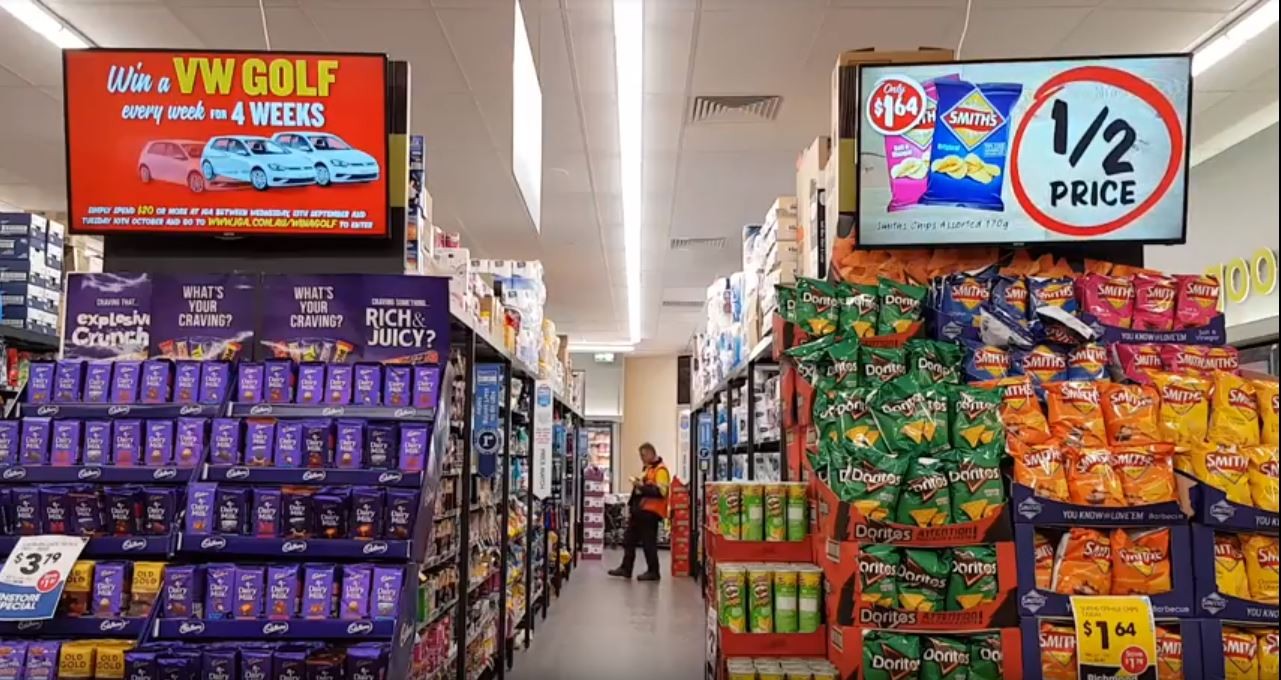
With all this talk of the next big wave of retail media being in-store advertising, I ask: can shopper marketing by any other name smell as sweet?
In this week's Retail Media Leapfrog post — strategies to help retailers navigate retail media by taking learnings from the past to build for the future — we delve into in-store advertising in a multi-part series on the practicality of in-store retail media. The focus areas for our in-store journey are:
- Better understanding the legacy of in-store media — this is important because it guides the next step.
- Collapsing and operationalizing the ecosystem in a frictionless way.
- Efficiently operating in-store retail media.
- Innovation in-store.
But first, let's take a look at some of the history.
Part No. 01The history of in-store media.
A while back I wrote about the democratization of entertainment in retail. When Sam Walton opened his second store in rural Arkansas, he wanted to create a first-day experience that attracted the town. He bought up every watermelon in the region and put them on sale for 10 cents. He then arranged for donkey rides as a form of entertainment outside the store. From there, retailtainment expanded exponentially across the entire sector — in-store demos, famous character visits, parking lot events, digital screens, skateparks in stores, pop-up shops, and more.
Then I looked at how retail media 2.0 looks a lot like trade marketing 1.0. In 1990, the dominant trade marketing tactics included in-store displays, coupons, flyers, radio, food sampling or product demos, and early forms of 'retailtainment' (sound familiar?). In 2008, Walmart introduced the in-store digital screen network and branded it SmartNetwork. By 2010, they had deployed 27,000 screens reaching over 140M shoppers per week.
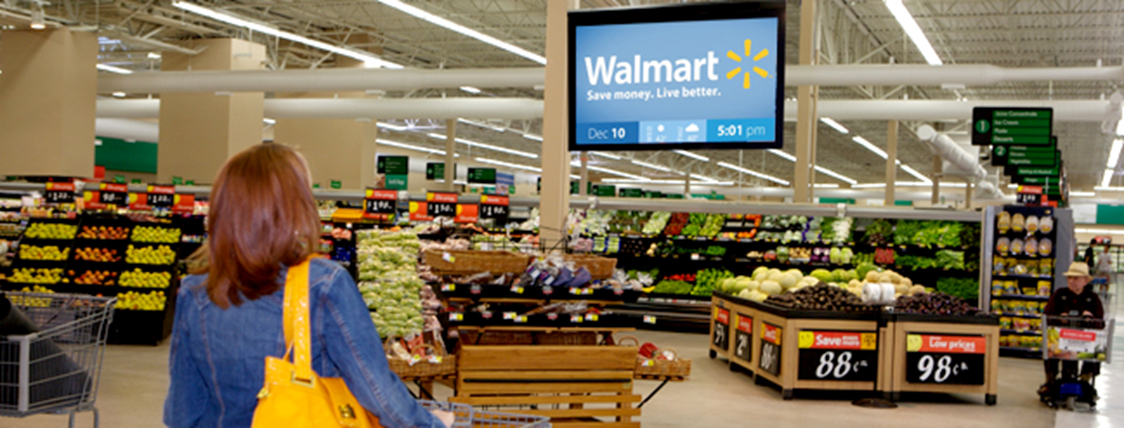
We've been through this before. Since 1990, a few things have changed: we have [some] tools to manage resourcing and workflows, making it easier to activate physical media in-store; digital screens are a little more connected and intelligent. But the core principles, tactics, measurement, supplier incentives, scalability, cost structures, and business models for in-store media remain reasonably consistent.
There's a lot more to this — from full-store wraps and website takeovers for the first Despicable Me movie in 2010, to giant snow globes in retailer parking lots in 2021. Almost all of it was co-funded by retail suppliers.
Part No. 02The 'new' in in-store.
One of my favorite slides from Andrew Lipsman's excellent series in Media, Ads + Commerce is below. It highlights the general scale of in-store traffic relative to linear TV.
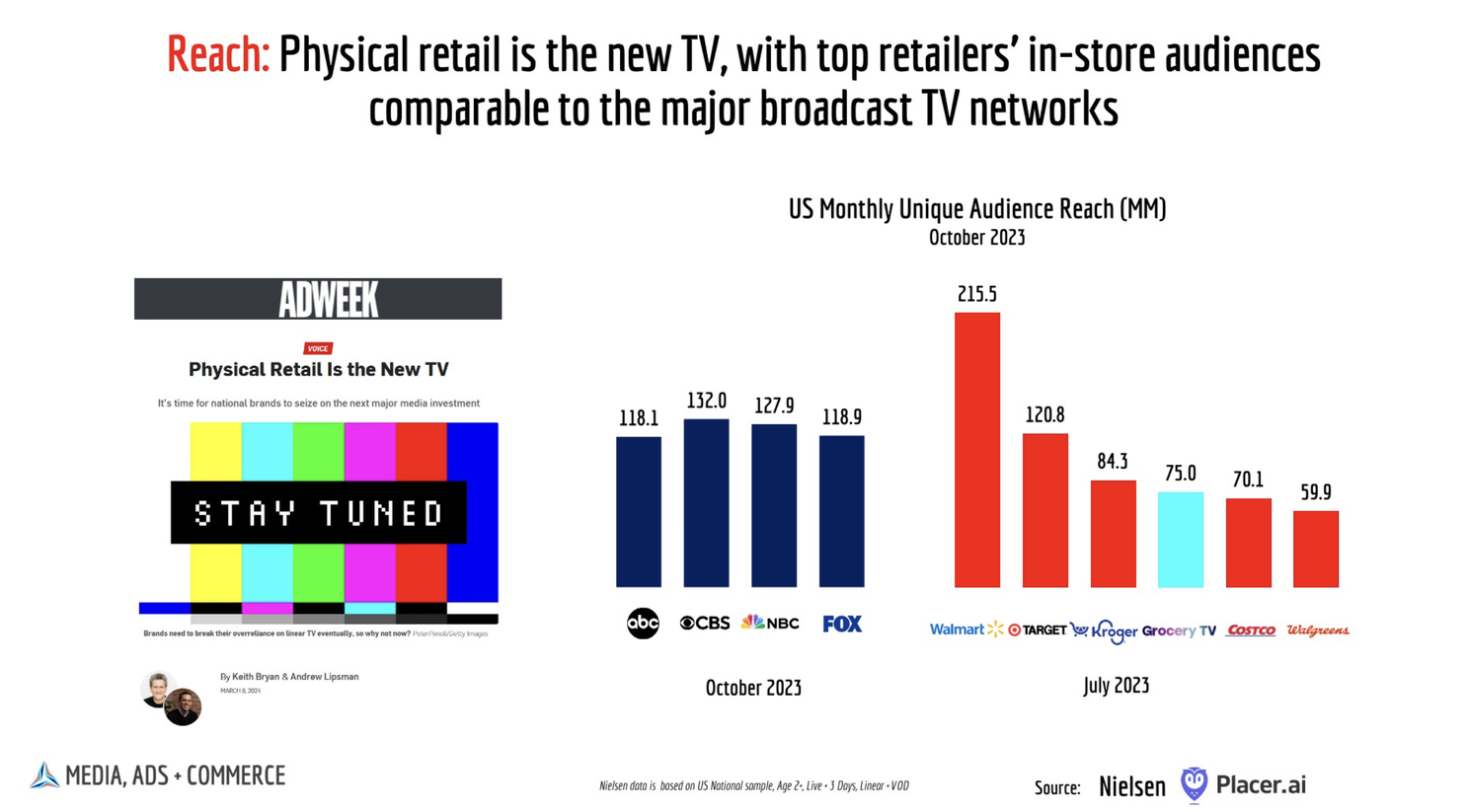
What Andrew suggests is that as dollars transition out of linear TV, their new home could very well be in-store advertising — one of the only places that can replace that scale. I used to say, "Walmart has a Super Bowl worth of customers walking through their doors every week."
Kathryn Lundstrom from ADWEEK often explores the fringes of in-store, including new pushes into non-endemic advertising in physical retail, noting that the scale above creates value for more than just brands selling at that retailer. And the IAB, under Jeffrey Bustos' leadership, is working to establish standards and guidelines for everything from formats to location and measurement — highlighting a growing excitement in this space from the media world.
All this suggests there is still room for growth and innovation in in-store advertising, even if the space is not new.
Part No. 03The in-store ecosystem.
When we first started exploring in-store within Walmart Connect circa 2019, I created this slide — one of my personal favorites (it has since been made public, hence why I still have it). It highlights the breadth of companies selling marketing services in and around the Walmart ecosystem 'on behalf of Walmart.' This ecosystem is consistent with most major retailers across the globe today.
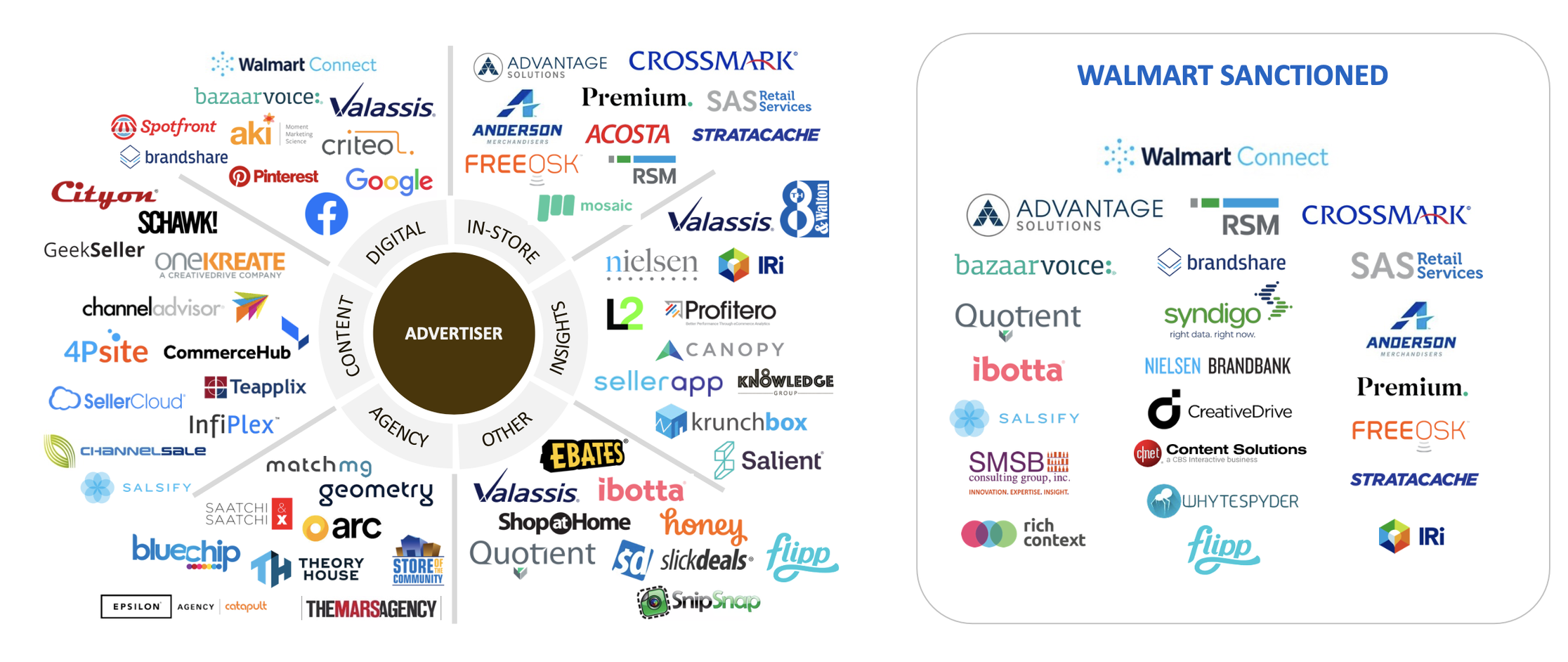
If you want an updated version for the broader retail industry, Eric Savitch from Path to Purchase Institute has just released a new omni-channel ecosystem view. As a retailer or retail media person, this ecosystem creates a lot of challenges:
- Competition for dollars pre-allocated to an individual retailer.
- Limited visibility into how supplier dollars are being invested within a retailer's ecosystem.
- Lack of control of outcomes.
- Hundreds of companies reaching out to a retailer's supplier base 'on behalf of the retailer.'
Equally, for a supplier (advertiser), the challenges include a lack of holistic measurement, no credit for investments, and the burden of managing this complex ecosystem. And most importantly, as a shopper, it's visual chaos. Teresa Aprile from Criteo makes a great point:
This ecosystem, in its current construct, does not support that outcome.
Part No. 04The engrained legacy of in-store advertising.
The in-store media ecosystem exists today, at scale, and has for at least the last 40 years. Because of that, there are a lot of ingrained behaviors that are core to retail operations.
When we were beginning the in-store retail media journey at Walmart Connect, we found at least 120 companies (probably more, in hindsight) powering some component of that in-store ecosystem — regional players, national networks, and even category-specific activations. All of it funded by suppliers.
At first, my approach was to start culling the list — working to reduce the number of companies allowed to operate within the walls of the retailer. What I quickly learned was that many of these smaller companies were co-funding other parts of retail operations.
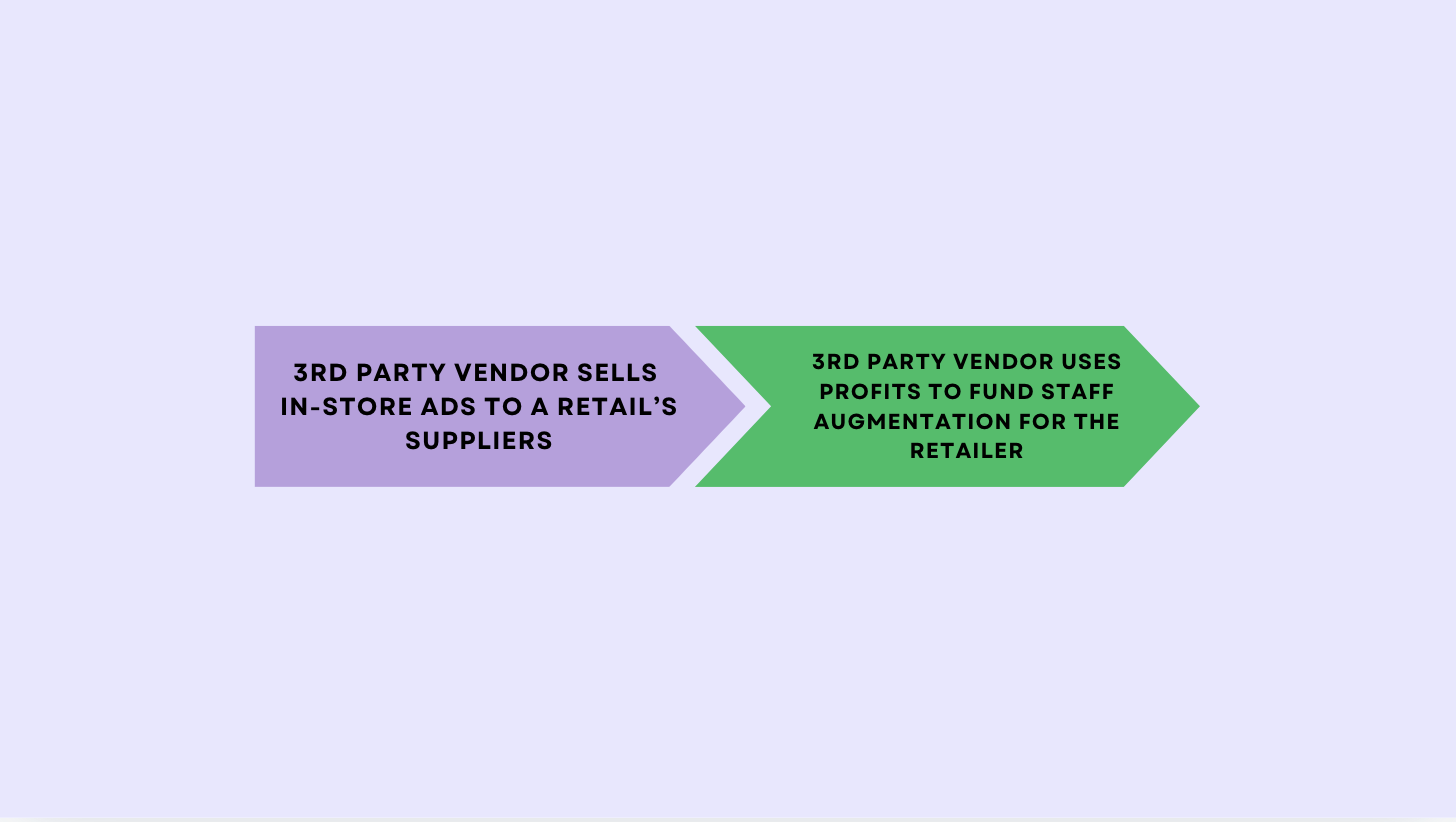
I use this big dramatic image to highlight how simple the model is. A lot of the MASSIVE in-store advertising ecosystem today is essentially a bartering deal funding a cost-offset for the retailer. Really.
What this means is that a change to this ecosystem can have a ripple effect into retail operations. It's a cautionary tale to the retail media industry: don't dive into stores without knowing what you're up against, and be thoughtful when making decisions around this space.
This is part one of a multi-part series on in-store retail media. Subscribe to the Retail Media Leapfrog Series so you don't miss the rest.